
Your own book agent
Write your book in your own voice, with AI.
So it stays. And maybe earns.
A 3-step system that turns what you already lived into a finished manuscript. Without writing. Without inventing a word. You send voice notes on Telegram, from your phone; it does the rest.

- You give it
- Thirty minutes a week
- You type
- Nothing
- It invents
- Nothing
- It remembers
- Everything, for years
One live project, counted
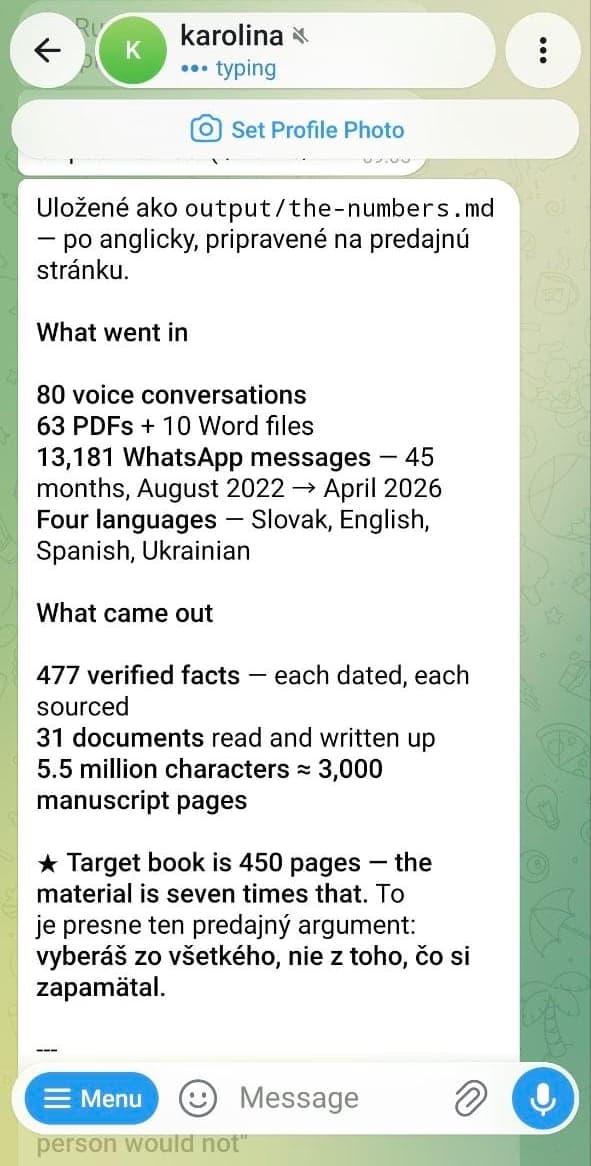
80 conversations 63 PDFs 13,181 messages 477 verified facts 0 invented
What it actually does all day
Think of it as a new hire, not an app.
You are not choosing software. You are deciding whether to hire someone — and anyone considering a new colleague wants to know what they do on a Tuesday, not a list of features.
It works on its own
Reads everything you hand it
Documents, archives, message exports, photographs. Files them, dates them, indexes them. Tells you if you send the same file twice.
Runs on a schedule
Morning briefings, monitoring, digests — delivered to your phone whether or not you remembered to ask.
Searches before it asks
If the answer is already in your files, it finds it rather than making you repeat yourself.
Checks what you tell it
Against everything it already holds. Every time.
Keeps its own records
Facts numbered, dated, sourced. Contradictions recorded. Nothing quietly rewritten.
Flags its own gaps
Keeps a live list of what is missing — and keeps asking.
Corrects itself
When it finds it was wrong earlier, it fixes the record and tells you.
It always asks first
Anything published
Nothing goes public without you.
Anything that costs money
Free plans only. If only a paid option exists, it stops and asks.
Anything sent to a person
Emails, messages, filings — you approve.
Deleting anything
It moves things aside. It does not delete.
The big decisions
What the book is about, how long, what order — yours.
These are settings, not laws. Want it to publish without asking? Say so. Want it to ask before touching a file? Say that.
A week with it
Five minutes about something you remembered. By the time you park, it is a dated record with four follow-up questions.
You drop a 97,000-character document in a folder. It reads all of it and comes back with three things nobody had noticed.
Your briefing arrives. You didn’t ask for it.
It asks the question you’ve been avoiding — because it has noticed the same gap in your file eleven times.
“Write that chapter.” It writes. “Too long, and I never said that.” It rewrites.
You’re not working. It is.
Chatbot or agent
A chatbot answers. An agent works.
If you have used a chatbot you already have a mental model, and it is the wrong one. A chatbot has one move: you ask, it replies, the conversation ends. Close the window and it is gone.
Memory · A chatbot
Forgets between sessions
Memory · Your book agent
Permanent. Facts, dates, sources and decisions — kept and searchable
Your files · A chatbot
You paste text in
Your files · Your book agent
Reads your folder directly. PDFs, Word, exports, photographs
Works alone · A chatbot
Never
Works alone · Your book agent
Yes — on a schedule, or when you give it a task
Reaches you · A chatbot
Only when you open it
Reaches you · Your book agent
Sends you the result on your phone
Verification · A chatbot
Agrees with you
Verification · Your book agent
Checks you against your own archive and tells you when you are wrong
Scale · A chatbot
One conversation
Scale · Your book agent
13,181 messages, 31 documents and 477 facts, held at once
What that means on a Tuesday
You say, in a voice note, “the handbag thing was in March.” A chatbot writes a nice paragraph about March.
Your agent searches 13,181 of your own messages, finds the one you sent from the airport, and answers: “21 February, not March. Here is your own message from the next day. Do you want me to correct the file?”
That difference is the entire product.
Why it hasn’t happened yet
You have the story. Something else is in the way.
You have the story. You don’t have the hours.
It’s 22:40. You’ve told this story a hundred times — at dinners, to friends, to lawyers. You’ve never written page one. Not because you can’t. Because page one takes an evening you don’t have.
You start, and three weeks later you can’t find anything.
Notes in one app, photos in another, the important email somewhere in 2023. You know the detail exists. You spend forty minutes looking for it and write nothing.
AI writes it — and it isn’t yours.
It comes back smooth, confident and empty. It invents a detail you never gave it. You delete it and you’re back to page one with less faith than before.
You can’t remember if it was March or February.
And you’re right not to trust yourself. One wrong date costs the reader’s belief in everything else.
The real problem
It isn’t you.
You don’t have a writing problem. You have a retrieval problem.
The story is already complete — in your head, in your phone, in a folder you haven’t opened in a year. What’s missing is something that holds all of it at once, finds the contradiction, and asks the one question that unlocks the chapter.
Writing is not talent. Writing is a system.
What you don’t need
You don’t need any of this.
You need
A story that’s yours, the material you already have, and thirty minutes a week.
Not a generator
This is not an AI book generator.
It’s the opposite of one.
Every AI writing tool solves one problem: “I want a book but I have no story.” This solves the opposite: “I have the story — and I can’t hold it all at once.” Those are not competing products. They are opposite products.
Who invents · AI story generators
The machine
Who invents · This
You. Nothing is invented — ever
Source · AI story generators
A prompt, a few hundred words
Source · This
Your documents, archives, recordings
Memory · AI story generators
This chat only
Memory · This
Permanent. Every fact dated and sourced
When you’re wrong · AI story generators
Agrees, and writes it
When you’re wrong · This
Corrects you with your own evidence
When you ask too much · AI story generators
Complies
When you ask too much · This
Refuses, and says why
Whose voice · AI story generators
The model’s
Whose voice · This
Yours
A true story with one invention in it is worthless. One fabricated detail and everything around it is suspect — and a reader who catches it is right to stop believing the rest.
An AI generator is a ghostwriter who never met you. This is a researcher who has read everything you own — and tells you when you’re wrong.
The part nobody believes
Everyone thinks voice notes have to be short. They don’t.
Five minutes. Twenty. Thirty. Longer. Transcribed in full, broken into dated facts, filed — and it comes back with the questions you left out.
Motorway. Dog walk. Airport queue. 23:40 when you can’t sleep.
One 30-minute note a week ≈ 4,000 spoken words. That’s a working pace.
You don’t need time to write a book. You need thirty minutes a week and something worth saying.
You never open a laptop. Not once.
The one habit worth keeping
One voice note, one event. Not because of length — because each note becomes its own record, with its own date and its own questions. Three to seven minutes is the sweet spot, ten is fine, and there is no hard limit. A thirty-minute note about one evening is perfect; a thirty-minute note covering nine years has to be taken apart afterwards.
The method
Capture. Verify. Write.
Talk. It files.
- Voice in, structured record out. A five-minute note from the car returns as a dated entry with the facts extracted and filed.
- Your documents, read once and remembered. PDFs, Word, exports, photographs. Upload the same file twice and it tells you which one it already is.
- Not transcription. A transcript is a wall of text you’ll never reread. This produces facts — dated, sourced, searchable.
It corrects you. With evidence.
- It checks you against your own archive. “You said March. Your own message dates it 21 February — here it is.” Real. He’d been wrong for two and a half years.
- It keeps the contradictions. The bestselling memoir this method is modelled on printed the evidence against the author’s own memory — and sold millions partly because of it.
- It refuses. Ask for something unprovable and it says no, with reasons. An assistant that agrees with everything hands you a book you can be sued over.
In your voice. Never invented.
- One absolute rule: nothing that did not happen. No invented dialogue, no composite scenes.
- Your voice, built from how you actually speak. The strongest line in this book is one the author said without noticing.
- Chapters you send back. Say “too long” or “that’s not what happened” — out loud. Every version is kept.
Behind the scenes
A chatbot has a conversation. This builds a case file.
A true story is made of thousands of small facts, scattered across documents, messages and memory — and no human being can hold them all at once. All four layers below exist to hold them.
Layer 1
Raw material — what you hand over
inbox/ · source/ · text/ · meta/ · conversations/You drop files in the inbox; empty means everything has been processed. Originals are renamed and stored untouched, the extracted text is filed separately for searching, and each document carries its own metadata — dates found, names found, size. Message archives are parsed and made searchable.
The original is never altered. A year later, if there is a dispute about what a document said, the untouched file is still there. Drop the same file twice and it tells you: “already ingested as D-006.”
Layer 2
Your voice
interviews/001 … 80.mdOne voice note becomes one file: the verbatim transcript at the top, the analysis below, the open questions at the end. Nothing is paraphrased away, because in a true story the exact words are the evidence.
This is why it can say: “On 13 September you said this. Today you’re saying something different.”
Layer 3
Facts — the core of the whole thing
atoms.md · 477 numbered linesEvery fact is one line: what happened, when, where it came from, and a status tag. The tags are the product.
- ✅verified — confirmed against the archive
- ⚠️claim — someone asserts it, unconfirmed
- ⛔your conclusion, not a fact — reached later, cannot be proven
- ★key scene — the ones the book is built from
- [TK]missing — a known gap, tracked until it is filled
When a chapter is written, only ✅ and ★ are used. The ⛔ lines stay in the file as the author’s opinion, clearly labelled as opinion — never printed as fact. Most people writing a true story have no way to tell these four apart after six months. That is how books get taken apart.
Layer 4
Decisions
STATUS · FORMAT-LOCKED · PENDING-SCENES · voice · chronology · open-questionsWhat the book is about, its shape, how it sounds. What is settled and will not be reopened. What you still owe. Every date found, every person, and everything still unresolved.
Decisions are written down so they are made once. Without this, every session re-litigates the same three questions and the book never starts.
One voice note, step by step
What happens when you send one voice note
You say, from the car: “I found her by the bins.” Six things happen before you get a reply.
What happens when you send one voice note
Transcribe verbatim
The whole note, word for word, into a new interview file. Nothing summarised away.
Check the archive
13,181 messages. Is there a trace of this? Does the date hold?
Break it into facts
Each one numbered, sourced and tagged with its status.
Cross-check against everything already in the file
Does any of it contradict something you said before, or something a document says?
Record what’s missing
Tagged [TK] and tracked until it is filled.
Tell you what is usable
What works as a scene, and what cannot be used at all — and why.
Step 4 is the whole reason this exists
The author believed he learned something at a court hearing. Cross-checking his own accounts against the file showed he learned it the next day, in a car park, from a medical record.
And then a second finding, which he had not seen: the application filed at that hearing contains nothing about it. Its silence is documentary proof that he did not know — worth more in a book than any claim he could make, because a reader can check it.
A person with a notebook does not find that. It requires holding 477 facts and 13,181 messages in view simultaneously.
What you can hand over
Give it anything with words in it.
Documents
PDF · Word · text · HTML · spreadsheets · presentations · EPUB · OpenDocument · RTF. A 97,800-character transcript, read end to end.
Message archives
★WhatsApp, Telegram, email and SMS exports. Years of messages, searchable by date, by phrase, or by silence. If you have years of messages with someone in your story, this is the single most valuable thing you can hand over — and almost nobody realises it can be handed over at all.
Images
JPG, PNG, screenshots, photographs. It doesn’t just store them — it reads them. Photograph a document and it reads the text back.
Audio
Voice notes of any length, interviews, meetings, phone calls, dictation, old family tapes. Long recordings are transcribed in chunks.
Video
The audio is extracted and transcribed.
Web pages
Give it a link and it reads the page.
The memory
It remembers. For years.
Come back tomorrow, next month, or in a year — it knows what you told it and when. Every fact carries the date you said it and the document it came from. Every voice note is kept verbatim, not summarised away.
Which means it can confront you
On 13 September you said the eviction was in November. Your own messages from that November show you watering her flowers and discussing rent.
And it holds itself to the same standard
When it was wrong about the evidence for two days, it found the error, wrote the correction permanently into the file, and flagged every conclusion that had depended on it.
What the memory is actually made of
Facts
Numbered, dated, sourced, status-tagged — verified, claimed, your conclusion, missing.
Your words
Every voice note, verbatim, with its date.
Documents
Originals plus the searchable text pulled out of them.
Decisions
What was settled, when, and why — so it is not re-argued every session.
Contradictions
Recorded, not smoothed away.
Gaps
What is still missing — and it keeps asking.
Nothing is lost between sessions. Nothing is quietly rewritten.
Your voice, not a template
No two books sound the same.
Every book starts with an interview about how it should sound. Not about the story — about the voice.
What you are asked, before a single word is written
Name books you love. Not by genre — by feel. Which one made you forget you were reading?
Which authors do you want this to resemble? One is enough. Three is better.
First person or third? Past or present?
How much should the narrator know — everything from page one, or only what you knew at the time?
Long chapters or short? (Short wins on Kindle — the reader sees “6 minutes left” and finishes it.)
What must never appear? Every author has a line. Name it now.
Who is this for — your family, or a stranger in an airport?
Then those books are analysed properly
Not “write like her”, but: how does she open a chapter, where does she end a scene, how does she handle time, when does she explain and when does she stay silent, how long are her sentences under tension? That becomes your rulebook — and the rulebook applies to sentences the original author never wrote.
And you keep training it
Every correction becomes a rule. Every “no, not like that” narrows the voice. Every preference you state — about length, tone, what stays in, what is never mentioned — is written down and applied from then on. By chapter ten it writes more like you than at chapter one, not because the model changed, but because your rulebook grew.
The book isn’t generated. It’s trained, by you, one correction at a time.
Start to finish
How a book actually gets written here.
The method is identical every time. The rulebook is different every time, because you set it.
From the first interview to the manuscript
The style interview
Before a single word. Seven questions about how the book should sound, and the books you name analysed into a rulebook that is then locked.
Stage 0 · voice.md · FORMAT-LOCKED.mdCollection
You talk. You hand over documents. It reads everything, files everything, and asks. Expect to be asked the same question several times if you haven’t answered it — that is deliberate.
Stage 1 · 80 sessions · 31 documents · 13,181 messagesVerification
Everything you say is checked against everything it holds. Contradictions are not smoothed away — they are recorded, and where memory and record disagree, both go in the book with a footnote.
Stage 2 · atoms.md · 477 factsStructure
Only once there is enough material: what the book is about in one sentence, where it starts, where it ends, how many chapters, and in what order. All of it decided from the material — none of it invented.
Stage 3 · premise.md · plot.md · chronology.mdWriting
Chapter by chapter. Each one lands as a file you can read on your own machine, or in the chat.
Stage 4Your corrections
You respond by voice. “Too long.” “That’s not what happened.” “The last version was better.” Every version is kept, so “go back” is a working instruction. And when you read a chapter, hunt for sentences that sound clever — those are the machine’s, not yours. Cut them without mercy.
Stage 5 · where the quality comes fromThe manuscript
Formatted to publishing standard, ready for an agent, a publisher, or Kindle.
Stage 6
The three rules that never change
Nothing that did not happen
No invented dialogue, no composite scenes, no “it probably went like this.”
Every fact carries its source
If it cannot be traced to a document or to your own words, it does not get written. Untraceable means unwritten.
Contradictions stay
Where memory and record disagree, both go in, with a footnote. A narrator who prints the evidence against himself is believed on everything else.
The costly admission
What it did to me.
I asked it to write someone in my story as ugly and childless. It said no. Three reasons: I couldn’t prove it, I could be sued, and a narrator who does that loses the reader for the whole book.
Then I asked it to describe how I found out — and it made me keep the part where I went out for pizza while my daughter was being born.
I didn’t enjoy either conversation. Both made the book better.
And one more, because hiding it would be worse
A scheduled job failed silently for three days and I didn’t notice. I only found out because I asked. Now it reports its own failures — so you learn when it is blind, not only when it works.
Buy this if you want a book that’s true. Don’t buy it if you want one that flatters you.
What else you could do
What else you could do instead.
This is the honest comparison. All four are real options, and one of them is free.
Hire a ghostwriter
What it costs
For non-fiction (Reedsy, 2026); $45,000–$80,000 for a 120,000-word memoir. Writes in their voice, not yours.
Use an AI generator
What it costs
It invents. One fabricated detail and the whole book is suspect — and a reader who catches it is right to stop believing the rest.
Buy a course on publishing
What it costs
Teaches you to write a book the market wants. Not the one only you can write — and you still do all of the work yourself.
Do it yourself
What it costs
Nine days of full-time work to discover what doesn’t work. That is exactly what this took.
This
What it costs
Your story, your voice, checked against your own archive. Installed on your own hardware, with training and a year of support.
They teach you to write a book the market wants. This helps you write the one only you can write.
Who it’s for
This is not for everyone, and that’s deliberate.
Yes, if
- you lived something and want it to stay
- you want to write your own book, not have a stranger write it
- you have material — documents, messages, photographs, recordings
- you’d rather talk for twenty minutes than type for two hours
- and yes — you’d like it to earn, once it exists
No, if
- you want fiction invented for you
- you have no source material
- you want a finished book this week
If you want passive income, buy a course — genuinely. If you have a story that won’t leave you alone, this is for you.
What we can prove
We have no testimonials yet. Here’s what we have instead.
The first installations haven’t produced customer quotes yet, and inventing them would contradict everything else on this page. What exists is a live project you can check.
Every number here comes from one live project
Counted 15 September 2026: 80 conversations, 63 PDFs, 13,181 messages, 477 verified facts and 31 documents written up — about 5.5 million characters, roughly 3,000 manuscript pages against a 450-page target. All of it checkable.
The agent’s own error log
A permanent record of its mistakes, written by the agent, including the correction it made to its own two-day-old claim. No competitor will show you this.
Jobs that have been running for months
A daily briefing at 06:00, monitoring at 08:00, alerts every fifteen minutes. Still running — and now reporting their own failures.
The refusal
Proof it won’t write whatever it’s told, with the three reasons it gave for saying no.
Privacy, stated precisely
- It runs on your hardware — your own server and laptop, not a website and not someone else’s cloud.
- Your documents are not uploaded anywhere and are not used to train anything.
- The underlying model is an external service. We say so rather than overclaim.
Naming that last exception is what makes the first two worth believing. So is the scanned-PDF limit above.
What you get
An installation, not a subscription.
A ~4 hour installation
On your own machine and server. You set nothing up — and you are talking to it the same evening.
Your assistant, by voice
24/7, from your phone, in Telegram — the app you already have. No new app, no login, no keyboard.
Your archive, private
On your hardware, indexed and searchable.
The method
Capture → verify → write, and the training to work it.
12 months of membership
Monitoring that it still runs, failure alerts, new jobs on request, updates when the tools change, community and support.
Why an installation and not an app
Because the value is not the model. It is the setup. Anyone can open a chatbot; what takes four hours is:
- Its own identity — its own email address, so it can subscribe, receive and act as itself rather than through your inbox
- Access to your actual material — documents, archives, exports, folders — indexed and searchable
- Scheduled work — the jobs that run whether or not you remember to ask
- Boundaries — what it may do alone, what it must ask about, what it may never do
- Memory that survives — so the second month is better than the first, instead of starting over
None of this is hard. All of it is fiddly, and none of it gets done by someone who is already short of time. That is the product: not software, but a working system, installed, tested and explained.
Why a year of membership
The tools change underneath it
Models are replaced, APIs move, a website changes its login page and a job that ran for months stops. Not hypothetical — it happened here within the first fortnight.
The system grows with use
The first month you use it for two things. By month six you want six more. Membership is what makes asking normal rather than awkward.
Silent failure is the real risk
An agent that stops working does not announce it. Membership includes monitoring that the jobs still run — and being told when one doesn’t.
Free tiers wherever a free tier exists. A standing rule, not a limitation — running it costs you nothing extra.
There is no free trial. This is not an app you try — it is an installation on your own hardware. The free 30-minute call with a demo is how you see it work first.
Objections
The fair questions.
+–I could set this up myself.
Yes, you could. It took nine days of full-time work to get this far, and most of that was discovering what doesn’t work. You’re buying the nine days, not the software.
+–Is my data safe?
It runs on your machines. Your documents aren’t uploaded and aren’t used to train anything. The underlying model is an external service — we say so plainly rather than overclaim.
+–What if it makes things up?
It will sometimes be wrong. What it won’t do is hide it. This project contains a permanent record of the agent’s own errors, written by the agent. Ask any other vendor for the same.
+–Won’t every book sound the same?
No. Every book begins with an interview about how it should sound, and the books you name are analysed into a rulebook that applies only to yours. You set it, and every correction you make narrows it further.
+–What if I don’t use it?
Then it was a bad purchase. The annual review exists to catch that at month twelve, not month thirty-six.
+–How long does a book take?
Months, because it’s real. Thirty minutes a week is a working pace; the limit is how much material you have and how quickly you answer the questions it keeps asking.
+–Do I need to be technical?
No. You need a computer we can install on, a phone with Telegram, and a story. We set everything up in one session and show you how to work with it. From then on you talk; it works.
+–Does it work in my language?
Yes. The live project is written in Slovak and English, and its archive holds Spanish and Ukrainian documents the agent read and filed like everything else. You speak to it the way you speak.
Start here
You talk. It remembers, checks, files and writes. The voice stays yours.
Tell us in one sentence what you want to write about. The call is thirty minutes, it’s free, and you’ll see the agent working on a real archive before you decide anything.
There is no price on this page on purpose — what it costs depends on what you already have. We’ll tell you on the call, and you’ll see it work first.